
We live glued to our screens. We work remotely, stream our entertainment and store our lives in the famous ‘cloud’. During the pandemic, technology was a great ally: it allowed us to keep the economy and society afloat through collaboration tools and online services. Yet we tend to forget that this digital world, seemingly invisible and ethereal, has a very real physical and environmental impact. According to estimates collected by Tom Greenwood in Sustainable Web Design, the internet uses more electricity each year than the whole of the United Kingdom, and its emissions, counting networks, data centres and devices, are comparable to those of global aviation.
Faced with this reality, and with ethical dilemmas around data privacy, ‘fake news’ and artificial intelligence, a key concept for any company has emerged: Corporate Digital Responsibility (CDR).
What exactly is CDR?
Corporate Digital Responsibility (CDR) is defined as a set of practices and behaviours that help an organisation use data and digital technologies in a socially, economically and environmentally responsible way. The term began to spread around 2018, especially in the DACH region (Germany, Austria and Switzerland), where governments and institutions started to call for ethical guidelines on the use of technology. The premise is simple: companies have an ethical responsibility to maximise the positive impact of digital technology on society and minimise the negative, going a step beyond what the law requires.
The 7 pillars of CDR
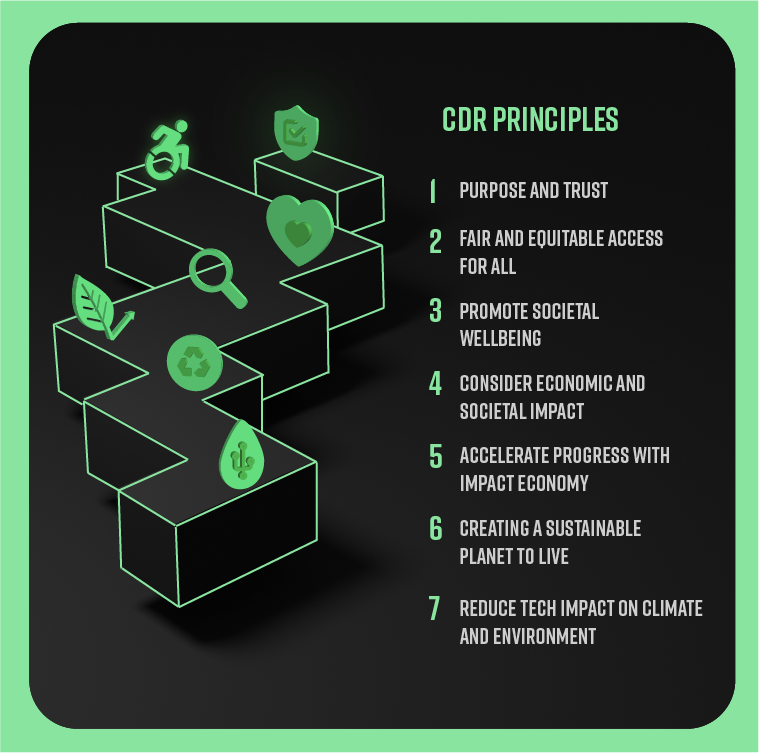
To guide organisations through this transition, a global group of academics, authors and practitioners created the International CDR Manifesto, structured around seven core principles:
- Purpose and trust: companies should publicly state their intention to have a positive influence on society and the planet. This means setting up strong governance, for example a Digital Ethics Board, and advocating better technology regulation in the regions where they operate.
- Fair and equitable access: technology should leave nobody behind. This principle calls for a commitment to equity, diversity and inclusion, ensuring that digital products are accessible to everyone. It also protects human and labour rights throughout the digital supply chain.
- Societal wellbeing: organisations must protect their users’ personal data and privacy. They must also fight behavioural manipulation, protect society from the harmful effects of their algorithms and tackle digital poverty.
- Economic and societal impact: the rise of artificial intelligence will change the world of work. CDR calls for ‘sustainable automation’ that includes retraining programmes for displaced workers and ensures algorithms are ethical and transparent for consumers and employees.
- Accelerating the impact economy: companies should use their purchasing power to boost green markets. This means supporting clean tech companies, investing in social impact initiatives and using verifiable carbon offsets, such as natural reforestation.
- Creating a sustainable planet: being carbon neutral isn’t enough; innovation is needed. Organisations should measure their impact against the UN Sustainable Development Goals (SDGs) and use technology to tackle the great global challenges.
- Reducing technology’s environmental impact: finally, a serious environmental strategy needs to be put in place. This includes switching to 100% renewable energy and applying responsible recycling practices to tackle the e-waste crisis.
How to avoid the ‘fog of enactment’
Today, the tech sector faces what has been called the ‘fog of enactment’: a period of ambiguity in which companies make big climate pledges but without a clear, auditable path away from fossil fuels.
Adopting CDR principles is a good tool for companies to clear this fog and avoid greenwashing. Investment funds and consumers are already demanding real transparency and penalising brands that use misleading tactics.
Corporate Digital Responsibility is not a marketing campaign: it is the ethical foundation on which to build the digital world. As Tom Greenwood, an expert in sustainable web design, points out, small, thoughtful changes in how technology is designed and developed can reduce environmental harm while making the web more resilient to a changing climate.
By adopting CDR, organisations not only protect the planet from invisible pollution but also build a fairer, more accessible and more human digital ecosystem for future generations. The web of the future will be responsible and regenerative, or it will not be at all.