
For years, the tech industry has operated under a dangerous illusion of control. We bought licences, deployed data centres and virtualised servers believing that, by hosting our own systems, we were masters of our own destiny. But the reality is that if you depend on a single closed supplier to run your business’s infrastructure, you don’t own your technology: you’re its hostage.
The idea of ‘software sovereignty’ is often dismissed in boardrooms as a debate for open-source purists. Yet Broadcom’s acquisition of VMware at the end of 2023 shows, very painfully, that technological sovereignty is a critical matter of financial viability and business survival.
What is VMware?
To put the case in context, imagine a traditional physical server as a detached house: it takes up a lot of land, is expensive to maintain and everything installed on it shares the same resources with no separation. What VMware popularised a couple of decades ago was ‘virtualisation’, which lets you divide a single powerful physical server into dozens of independent ‘virtual machines’.
Thanks to this, companies no longer needed whole rooms full of computers. They saved millions on hardware, space and electricity. As a result, VMware became the benchmark standard, the central nervous system of almost every data centre in the world. If a reasonably large company had its own servers, all its accounting, databases and internal processes were most likely running on VMware.
It was an omnipresent, vital infrastructure. That’s why a change in the rules of the game shakes the foundations of hundreds of thousands of companies.
The Broadcom–VMware earthquake (2023–2026)
From its early days, VMware operated as an indispensable giant (and an apparently stable partner) whose business model was based on perpetual licences: companies bought the right to use the software once and simply paid a reasonable annual fee for support and updates.
That was blown apart on 22 November 2023, when chipmaker Broadcom officially closed its acquisition of VMware for 69 billion dollars.
To grasp the scale of the problem, you only need to look at the moves Broadcom made almost immediately after completing the purchase, which changed the rules for thousands of IT departments:
- End of perpetual licences: overnight, the traditional purchase model disappeared. Customers were forced onto recurring subscription models, with no way of keeping their previous pricing.
- Aggressive metrics and forced bundles: Broadcom scrapped affordable licences (such as the former Essentials Plus Kit) to group services into large suites (VCF or VVF), forcing companies to pay for premium features they didn’t use. It also switched to per-core pricing, with a strict minimum of 16 cores per CPU.
- Dismantling the partner ecosystem: the huge global partner programme was taken apart. Broadcom cut its authorised cloud service providers from more than 4,500 to around 300 ‘Premier’ partners, isolating SMEs and drastically reducing customer choice.
The result? Between 2024 and 2026, companies of all sizes have faced contract renewals with cost increases of between 300% and 1,000% (and, in some cases reported by European associations, up to 1,500%). Entire budgets have been wiped out by decisions taken in a boardroom to which customers were not invited.
The ‘milking’ strategy
Analysts wondered how Broadcom could justify a price rise knowing that thousands of small and medium-sized businesses would flee. The answer is purely financial: Broadcom didn’t buy VMware to sell more licences, but to squeeze the customers who can’t escape.
Its business model is based on identifying large multinationals (banks, airlines, governments) whose infrastructure is so critical that migrating to another solution would cost them hundreds of millions and years of work. Broadcom knew that, for these giants, paying 500% more for licences is still cheaper in the short term than rebuilding their entire architecture.
By focusing on this top tier, Broadcom accepted losing a large share of its smaller customers. SMEs were acceptable collateral damage.
The strategic danger of vendor lock-in
The VMware case is not a glitch in the system: it is the logical consequence of depending on proprietary software with no alternatives. Broadcom was able to carry out this financial manoeuvre precisely because of the extreme level of vendor lock-in its customers were in. Migrating dozens or hundreds of virtual machines isn’t as simple as switching email client. It means restructuring security protocols, adapting storage, accepting downtime and managing a high operational risk.
This corporate hostage-taking may look like a problem only for systems engineers and huge data centres, but the reality is that micro-businesses and SMEs suffer the same dynamic, on a different scale, every day.
Take graphic design. For years, the industry adopted Adobe’s tools as the standard. When Adobe moved from selling perpetual licences to imposing compulsory monthly subscriptions, agencies and freelancers realised that if they stopped paying, they lost not only access to the software but also the ability to open and edit their own archive files in closed formats such as .psd or .ai. They were trapped.
Exactly the same happens with the most basic form of communication: email. A company that uses a free Gmail address has no sovereignty; if Google decides to close that account because of a policy change, the company disappears digitally. The most basic sovereignty for a small business starts with owning its own internet domain (@yourcompany.com). If your email provider suddenly triples its prices, owning the domain lets you change the records and receive your email with another provider within hours.
If you’d like to dig deeper, this video looks at the Broadcom–VMware case in more detail:
The video loads from YouTube when you press play. Once it plays, YouTube may store data in your browser.
Software sovereignty as a business imperative
Against corporate hostage-taking, software sovereignty is an effective vaccine. Being sovereign doesn’t mean building hypervisors from scratch or rejecting every commercial tool; it means guaranteeing, legally, technically and operationally, that you’re free to change course when a supplier’s terms become abusive.
A firm stance on software sovereignty rests on three pillars:
- Open standards and portability: architectures should be designed to be vendor-neutral. Prioritising open standards ensures workloads can move between servers or clouds without traumatic re-engineering or getting trapped in closed tools.
- Validated open alternatives: the mass exodus after Broadcom has shown that you don’t need closed, proprietary hypervisors to run critical operations. The big alternative that has emerged is KVM (Kernel-based Virtual Machine). The advantage? It’s a 100% open-source virtualisation technology built directly into the Linux kernel. It doesn’t belong to any corporation that could change the rules on you tomorrow. Providers we work with, such as Hostinger and Dinahosting, run their VPS on KVM. It shows that open source is already a mature, secure industry standard, free of abusive licences.
- Exit strategies by design (the exit plan): no critical piece of software should be adopted without a documented way out. A good exit plan isn’t an abstract idea; it translates into very specific actions:
- Owning your data in standard formats: making sure your CRM or ERP lets you export your entire customer base as a simple CSV at any time.
- Control of key assets: being the administrative owner of all your domains and hosting accounts, and never registering them in a third party’s name.
- Avoiding non-essential proprietary features: not tying yourself to native tools exclusive to one cloud provider if a standard database does the same job and lets you change servers tomorrow.
Our position
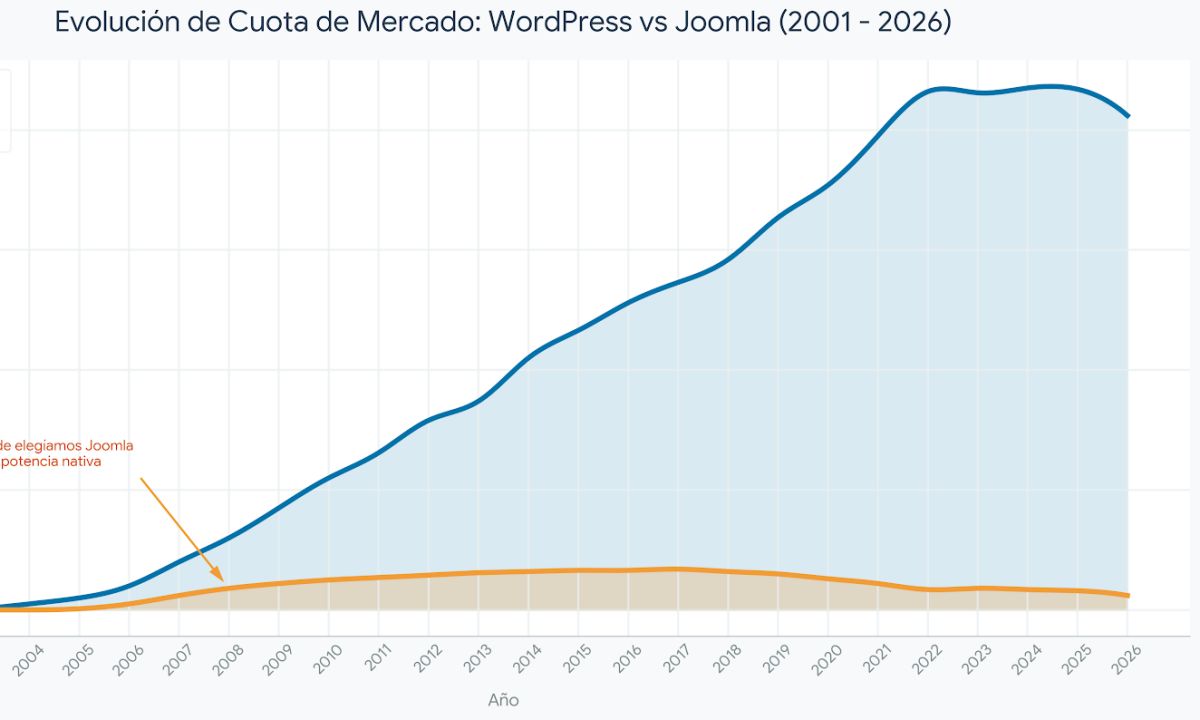
When we design digital strategies and system architectures, our priority is client autonomy. We apply this at every level: from choosing WordPress to guarantee full ownership of the website rather than renting a platform (something we’ve written about before) to our own way of working. We deliver projects structured so that the client is in control at all times. If one day they decide to move their platform, data or processes to any other tool or provider, they are free to do so whenever they like, with no code that ties them in and, of course, with no exit fees or penalties.
The Broadcom and VMware case will go down in history as a warning to anyone running corporate infrastructure. It has reminded us that critical proprietary technology behaves like a variable-rate loan, where the bank reserves the right to change the terms as it pleases. It’s time to stop being vulnerable tenants of someone else’s infrastructure: real control of your business starts with control of your own software.