We’ve been saying for years that websites pollute too. Every visit moves data through data centres, networks and devices, and all of that uses electricity. We say it, and more and more people are saying it. The problem was that when a client asked us ‘what about mine?’, the honest answer was: ‘Hang on, let me check three different tools’, none of which were available in Spanish or Catalan.
So we built our own.
What websostenible.com is
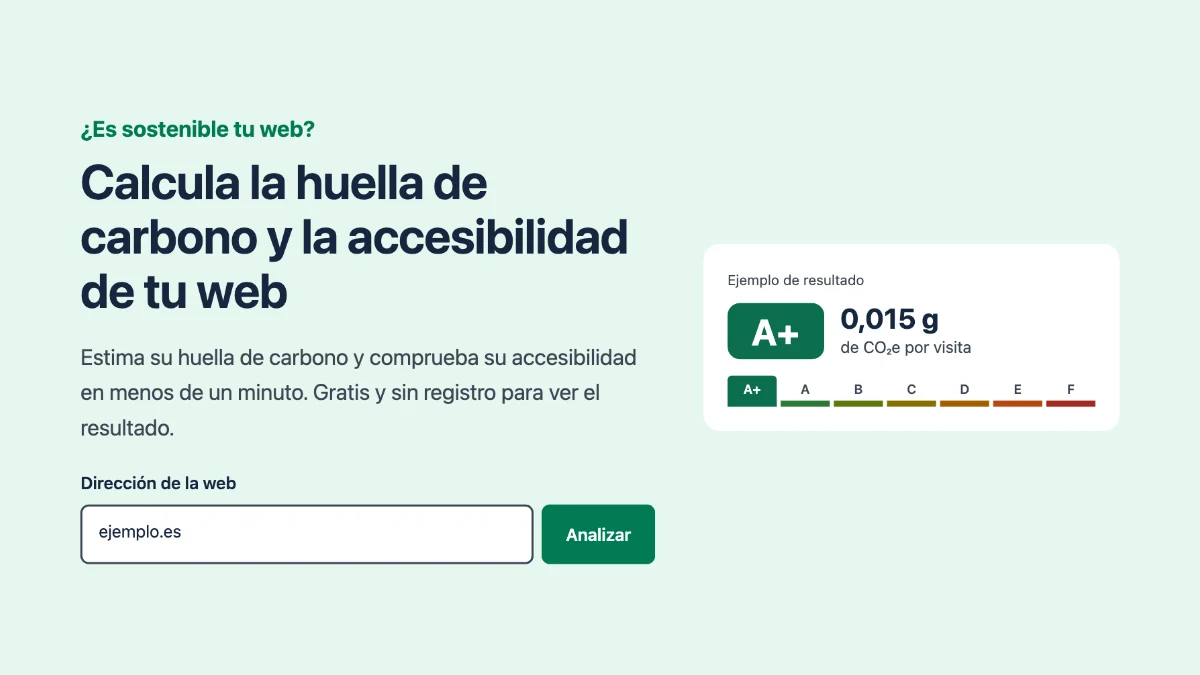
websostenible.com is a free tool that estimates a web page’s carbon footprint and checks its accessibility. You type in the address, press ‘Analyse’ and get the result in under a minute. There’s no need to sign up, and it’s available in Spanish, Catalan and English.
It tells you three things:
- How much CO₂ each visit emits, on desktop and mobile, with a grade from A+ to F.
- Whether your hosting runs on renewable energy, according to the Green Web Foundation’s register.
- Which accessibility issues can be detected automatically, based on WCAG 2.2.
And, above all, where to start improving.
Why accessibility and sustainability go together
Because a website that some people can’t use isn’t sustainable, however little it weighs. Both are about the same thing: building websites that work for everyone without using more than necessary. That’s why we measure them together, though we don’t mix them up: the grade is for carbon only, and accessibility has its own section.
What it’s built with
We haven’t invented anything, and we’re proud to say so. websostenible.com relies on open-source tools that the community has used and reviewed for years:
- The Sustainable Web Design model, the most widely used public method for estimating a website’s emissions.
- CO2.js, the Green Web Foundation’s library that applies that model.
- The Green Web Foundation’s own green hosting register.
- axe-core, the reference engine for accessibility testing.
- Playwright, which loads each page in a real browser to measure what is actually transferred.
If you know Website Carbon or Ecograder, you’re on the right track: they’re the tools that inspired us, and they’re still great. We wanted one in our own language that also looked at accessibility.
What it isn’t
It isn’t a certificate or an audit. The footprint is an estimate calculated with a model, not an exact measurement. And automated accessibility testing only picks up some of the issues: getting no warnings doesn’t mean a website is accessible. For that, a person needs to review it.
We’d rather be that clear. A tool that promises more than it measures helps nobody.
Starting at home
The first thing we did was run nicnac.es through the tool. It got an F on desktop. An agency that talks about sustainability, with an F.
We took it for what it was: a to-do list. Oversized images, fonts loaded from external servers and third-party scripts that weighed more than all our content. We fixed them one by one, measuring after each change. The home page went from 2.99 MB to under 0.6 MB, and from 0.36 to 0.07 grams of estimated CO₂ per visit: five times less. Today, if you analyse nicnac.es or websegura.io, both get an A on desktop and mobile. And websostenible.com, which couldn’t do any less, gets an A+: its home page weighs 15 KB, less than many icons. All three reports are public if you want to check.
We’re not telling you this to show off, but because it proves it can be done, and that most of the work is invisible: the website looks exactly as it did before.
Try it on yours
Go to websostenible.com, enter your website’s address and see what comes up. It’s free, takes less than a minute and we won’t ask you for anything in return.
And if you don’t like the result, don’t worry: we didn’t like ours either.