If you’ve been around the internet for a few years, you’ll remember when building a website meant almost nothing but hand-coding. Today, almost everyone assumes that if you’re launching a digital project, you’ll do it with WordPress. But if we look back a quarter of a century, the picture was completely different.
To understand how WordPress came to power more than 40% of the web, we first need to understand where we came from and why, for a long time, the king (at least for certain kinds of project) was someone else.
Why we were a Joomla shop in our early days
In the mid-2000s, when we had to take on complex projects (news portals, intranets or corporate websites with hundreds of pages and access levels), Joomla was our first and almost only choice.
Not because it was fashionable, but because it was technically far superior to anything else on the market.
Joomla was officially born in 2005 (as a fork of an earlier project called Mambo) and came with features that were advanced for the time: it let you build complex content structures thanks to its system of sections, categories, articles and modules.
What’s more, if a client wanted the marketing department to edit only the blog and HR to touch only the job listings, Joomla let you manage permissions and user levels with a precision that seems basic today but that hardly anyone offered back then.
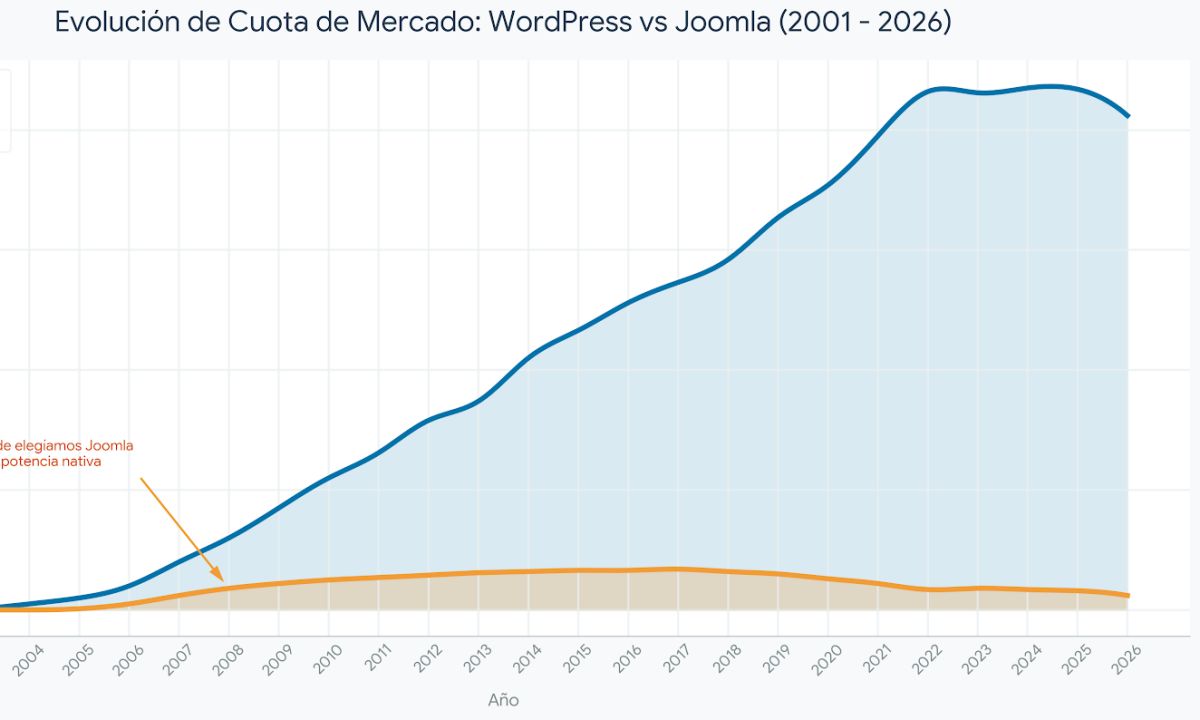
And WordPress? Well, WordPress had appeared a couple of years earlier (2003), but at the time it was essentially a blogging engine. Full stop. If a client needed a powerful corporate website, with several languages and different types of data, WordPress fell short unless you coded patches. That’s why, for quite a few years, Joomla was our unconditional ally.
WordPress’s moment
But technology moves fast, and the community behind WordPress didn’t sit still. It didn’t overtake Joomla overnight: it was a gradual process in which they absorbed and simplified everything that made Joomla great.
For us, the real turning point came in 2010. WordPress released version 3.0 and introduced a feature that changed the rules of the game: custom post types and taxonomies. Suddenly, you were no longer limited to writing ‘blog posts’. You could create products, property listings, business directories or anything the client needed.
But here’s the key detail, the real reason for the shift: WordPress managed to add all that powerful engine under the bonnet without making life difficult for the end user.
Let’s be honest: teaching a client to use the Joomla admin panel took patience, PDF manuals and more than one call for help. WordPress, on the other hand, made it possible for almost anyone with basic office skills to manage their own website without headaches. It let us hand over the project and give the client real autonomy.
The ecosystem
Over time, the demands of the internet changed at dizzying speed. A well-structured website was no longer enough; loading speed, being fully responsive on mobile, SEO and, above all, ongoing security now mattered enormously.
In this context, two things happened. On the one hand, the WordPress developer community exploded. Plugins such as WooCommerce (which democratised e-commerce) appeared, along with visual builders that made design and maintenance far easier. A huge ecosystem grew up in which there was a tried-and-tested plugin for almost any need.
On the other hand, maintaining Joomla became a risk. Major Joomla upgrades (like the dreaded jump from version 1.5 to 2.5, or from 2.5 to 3.0) were not a simple click. In many cases, they were traumatic migrations that meant rebuilding whole parts of the website and praying that the database wouldn’t blow up or the extensions stop working.
That’s when the market as a whole, and we along with it, started standardising new builds on WordPress. We needed platforms that were scalable, secure and, above all, maintainable in the long term without bankrupting the client with every software update.
Joomla was a key piece for us, a school of web development and a tool we have great respect for, given the power it brought in its early days. Even today there are Joomla websites working perfectly well in very specific niches.
But the reality is that WordPress’s ability to offer a robust technical foundation, combined with its ease of use and a huge community, has given it the crown of the modern web.
Ultimately, the priority isn’t to ‘marry’ a system, but to use the best possible tool so that the business works and grows, and, above all, so that our clients can sleep easy.
If your current website is built on Joomla and you’re thinking of moving to WordPress, at Nicnac we know both platforms inside out. These projects are handled by Websegura, our maintenance brand, which manages the whole process of migrating from Joomla to WordPress (page in Spanish): moving all your content, adapting the design to current accessibility standards and protecting your search rankings.